Zinc Selenide ZnSe Evaporation Process Notes
Zinc selenide is a chemical compound with a chemical formula of ZnSe. It is yellow to red in appearance with a melting point of >1,100°C, a density of 5.42 g/cc, and a vapor pressure of 10-4 Torr at 660°C. Zinc selenide is heavily used as an infrared optical material. It is evaporated under vacuum for infrared optical coatings, more specifically, night vision optical coatings.
Zinc Selenide ZnSe Specifications
| Material Type | Zinc Selenide |
| Symbol | ZnSe |
| Color/Appearance | Yellow to Red, Crystalline Solid |
| Melting Point (°C) | >1,100 |
| Theoretical Density (g/cc) | 5.42 |
| Sputter | RF |
| Type of Bond | Indium, Elastomer |
| Z Ratio | 0.722 |
| Thermal Evaporation Techniques |
Boat: Ta, W, Mo Coil: W, Mo Basket: W, Mo Crucible: Q |
| E-Beam Crucible Liner Material | Tantalum, Molybdenum |
| Temp. (°C) for Given Vap. Press. (Torr) | 10-4: 660 |
| UN Number | 3283 |
| Comments | Preheat gently to outgas. Evaporates well. |
Z-Factors
Empirical Determination of Z-Factor
Unfortunately, Z Factor and Shear Modulus are not readily available for many materials. In this case, the Z-Factor can also be determined empirically using the following method:
- Deposit material until Crystal Life is near 50%, or near the end of life, whichever is sooner.
- Place a new substrate adjacent to the used quartz sensor.
- Set QCM Density to the calibrated value; Tooling to 100%
- Zero thickness
- Deposit approximately 1000 to 5000 A of material on the substrate.
- Use a profilometer or interferometer to measure the actual substrate film thickness.
- Adjust the Z Factor of the instrument until the correct thickness reading is shown.
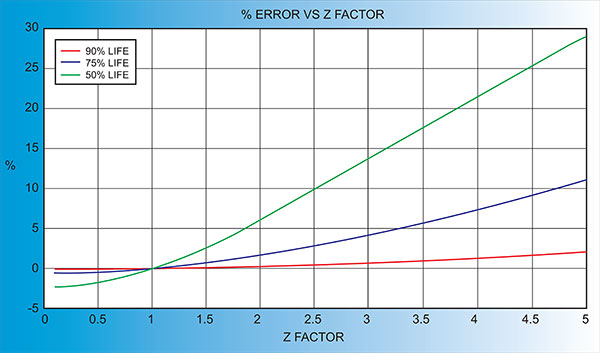
Another alternative is to change crystals frequently and ignore the error. The graph below shows the % Error in Rate/Thickness from using the wrong Z Factor. For a crystal with 90% life, the error is negligible for even large errors in the programmed versus actual Z Factor.